

What Is Flexible Packaging? Is It a Smart Choice for Bakery Products?
Learn what flexible packaging is and how it protects bread, biscuits, and cookies. See the types, materials, benefits, and limits for bakery brands.
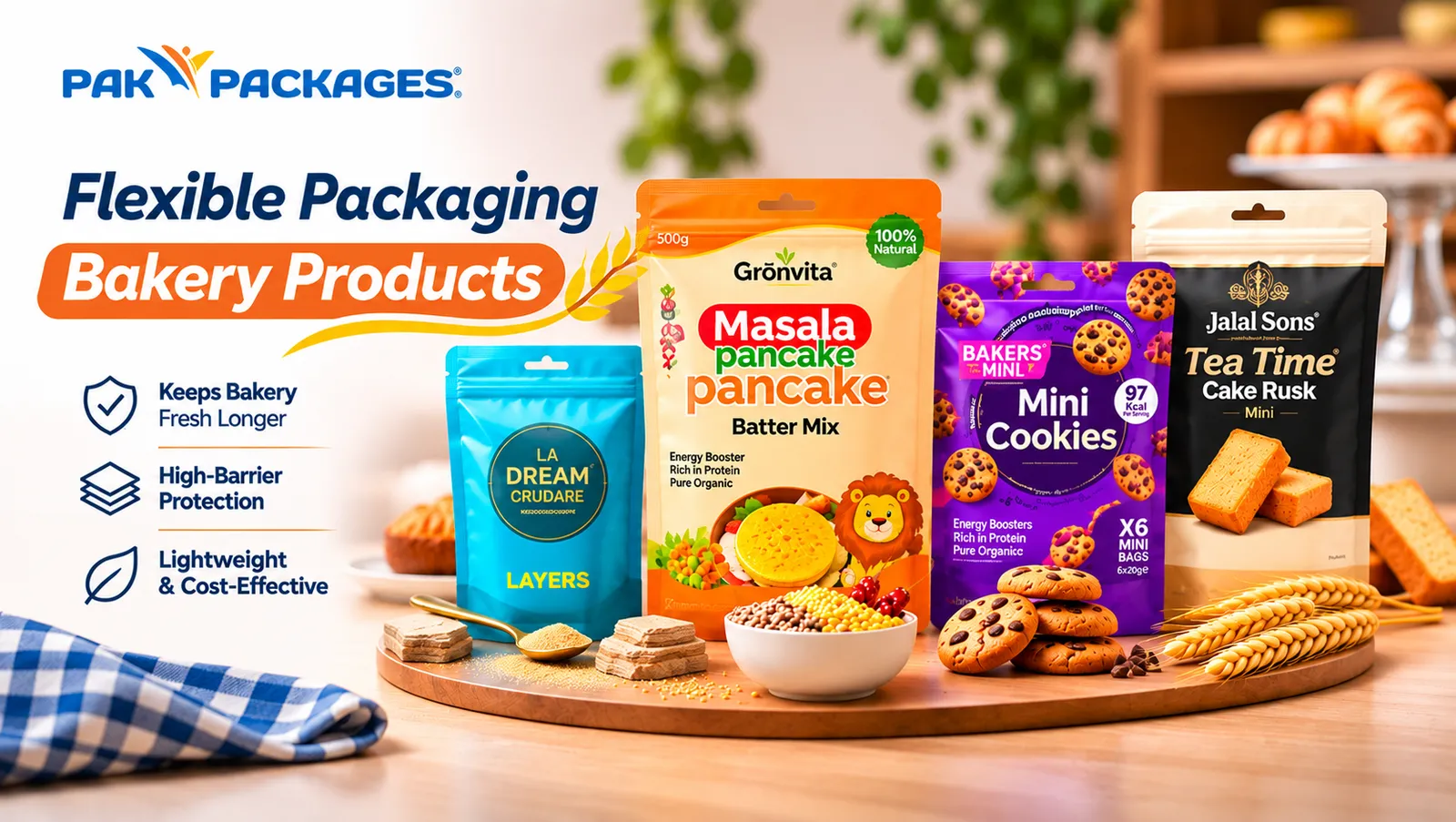
Think about the biscuit pack in your kitchen, the bread bag on your counter, or the cookie pouch from your favorite Lahore bakery. All of them are flexible packaging. It means any pack whose shape can change easily, such as a pouch, a wrapper, or a bag. Bakery brands are using it more every year because it keeps products fresh, looks good on the shelf, and costs less to ship than boxes or tins. At Pak Packages, we get many questions from bakers asking if it is right for their products. The short answer is yes for most items, with a few exceptions. Let us look at both sides.
What Is Flexible Packaging?
Flexible packaging is made from thin, bendable materials like plastic film, aluminium foil, paper, or a mix of these. Makers join two or more layers through lamination. Each layer has a job. One gives strength, one blocks moisture and air, and one seals the pack. Unlike a glass jar or a tin, a flexible pack can bend, fold, and fit the product inside it.
Common Types of Flexible Packaging
- Flow wrap: a tight wrapper made on a machine, common for biscuits, cakes, and rusks
- Stand-up pouches: stand on the shelf, good for cookies and granola
- Flat bottom pouches: stable and box-like, good for premium cookies
- Lay-flat pouches: simple and light, good for single items
- Roll stock: film on a reel, used on automatic filling lines
- Paper bags with a window: popular for bread, buns, and artisan items
Materials Used in Flexible Packaging
The right material depends on what you bake. These are the most common ones.
- BOPP (biaxially oriented polypropylene) is clear, glossy, and takes print well
- CPP (cast polypropylene) is soft and seals well, often used as the inner layer
- PE (polyethylene) is flexible and heat sealable, common for bread bags
- PET (polyester) adds strength and a strong printed look
- Nylon (OPA) resists punctures and adds an oxygen barrier
- Aluminium foil gives the best barrier against light, air, and moisture
- Kraft paper gives a natural look, usually with a thin barrier lining
What Do Bakery Products Need From Packaging?
Bakery items are sensitive. Each type has a different enemy.
- Biscuits and cookies: pick up moisture and go soft. They need a good moisture barrier
- Bread and buns: dry out and grow mold. They need a soft film that holds moisture and keeps clean air out
- Cakes and pastries: lose freshness and can go rancid from fats. They need an oxygen barrier and a grease resistant layer
- Rusk and namkeen items: need to stay crisp for weeks
- Cream and filled items: need a clean, tight seal
A single pouch cannot fix all of these. This is why choosing the right structure matters more than choosing a trendy format.
Why Flexible Packaging Is a Smart Choice for Bakery Products
1. Longer Shelf Life
A good laminate blocks humidity, oxygen, and light. The result is a longer shelf life for your product. This is a big deal in Pakistan, where summer heat and humidity can make biscuits soft in days. Makers measure protection with MVTR (moisture vapor transmission rate) and OTR (oxygen transmission rate). Lower numbers mean better protection.
2. Strong Shelf Appeal
A pouch or wrapper gives you a large printing area. With rotogravure printing, you get sharp colors that make cookies look tasty even before the customer opens the pack. A clear window lets people see what they are buying. For small bakeries, this makes the product look more professional.
3. Lower Cost
Flexible packs weigh less than boxes and tins. Empty pouches ship flat and take little storage space. This cuts freight and warehouse costs. Home bakers and online sellers also pay less to courier a light pouch than a rigid box.
4. Easy to Use
A resealable zipper lets customers close the pack and eat the cookies over several days. A tear notch helps open the pack without scissors. Easy packs get repeat buyers, and that is what every bakery wants.
5. Suits Short Runs and Seasonal Items
Bakeries often launch Eid boxes, Ramadan specials, and wedding favors. Flexible packaging works well for these limited batches, as long as you check the MOQ (minimum order quantity) with your supplier in advance.
Flexible vs Rigid Packaging for Bakery
| Feature | Flexible Packaging | Rigid Box or Tin |
|---|---|---|
| Weight | Very light | Heavy |
| Shipping cost | Low | Higher |
| Storage before use | Flat, small | Bulky |
| Crush protection | Low to medium | High |
| Printing area | Full surface | Limited |
| Best for | Biscuits, cookies, bread, rusk | Tall cakes, gift hampers |
When Flexible Packaging Is Not the Best Choice
Be honest about the limits. Flexible packs do not protect fragile or tall items well. A decorated cake, a tray of pastries, or a delicate meringue can get crushed in a soft pouch. For these, a rigid box with a flexible wrap inside works better. Also, multi-layer laminates are hard to recycle, and recycling options in Pakistan are still limited. If sustainability matters to your buyers, ask your supplier about mono-material pouches or paper-based options.
How to Choose the Right Flexible Packaging for Your Bakery
- Check your product type: crisp, soft, fatty, or filled
- Pick the right barrier level for the shelf life you need
- Choose the format: flow wrap, pouch, or bag
- Add features you need, like a zipper, window, or tear notch
- Make sure the inner layer is food-grade and meets FDA or Pakistan Standards and Quality Control Authority (PSQCA) rules
- Test a small batch before a full order
If you want custom printed bakery pouches or wrappers, Pak Packages can help you match the right structure to your product.
Mistakes to Avoid
- Using a low-barrier film for biscuits and cookies
- Choosing the wrong size, which leaves the pack half empty
- Ignoring seal strength, which lets air in
- Printing tiny text that is hard to read on the shelf
- Skipping a shelf life test
FAQs
What is flexible packaging?
Flexible packaging is any pack made from bendable materials like film, foil, or paper whose shape changes easily.
Is flexible packaging good for bakery products?
Yes, flexible packaging is good for most bakery products because it protects from moisture and air while staying light and low in cost.
Which flexible packaging is best for biscuits and cookies?
The best flexible packaging for biscuits and cookies is a laminate with a strong moisture barrier, like metallized film or BOPP with a sealing layer.
Which packaging keeps bread fresh the longest?
A sealed PE or laminated bread bag keeps bread fresh the longest because it holds moisture and blocks outside air.
Is flexible packaging food safe?
Yes, flexible packaging is food safe when the inner layer is food-grade and meets FDA or PSQCA requirements.
Can flexible packaging be recycled?
Flexible packaging can be recycled only when it uses a mono-material structure, because multi-layer laminates are very hard to recycle.
Does flexible packaging help bakery items stay fresh in hot weather?
Yes, flexible packaging helps bakery items stay fresh in hot weather when the film has a strong barrier and the seal is tight.
Conclusion
Flexible packaging is a smart choice for most bakery products. It keeps biscuits crisp, bread fresh, and cookies looking great, and it costs less to ship. Just match the barrier to the product, and use a rigid box for fragile cakes. To get custom flexible packaging for your bakery, call Pak Packages at +92-42-35114103.